



-
Partager cette page
About the CLLE Laboratory
The CLLE (Cognition, Languages, Language, Ergonomics) laboratory is a CNRS joint research unit established in January 2007 and primarily based at the University of Toulouse Jean Jaurès.
The laboratory is part of the CNRS Institute of Humanities and Social Sciences and is primarily affiliated with CNRS Section 36 (Language Sciences) and, to a lesser extent, with CNRS Section 28 (Cognition, Brain, Behavior) of the CNRS Institute of Biological Sciences. CLLE is therefore a multidisciplinary research unit within the field of Cognitive Sciences: the research conducted there spans the fields—to a greater or lesser extent—of linguistics, psychology, computer science, philosophy, education, and neuroscience.
Organization chart
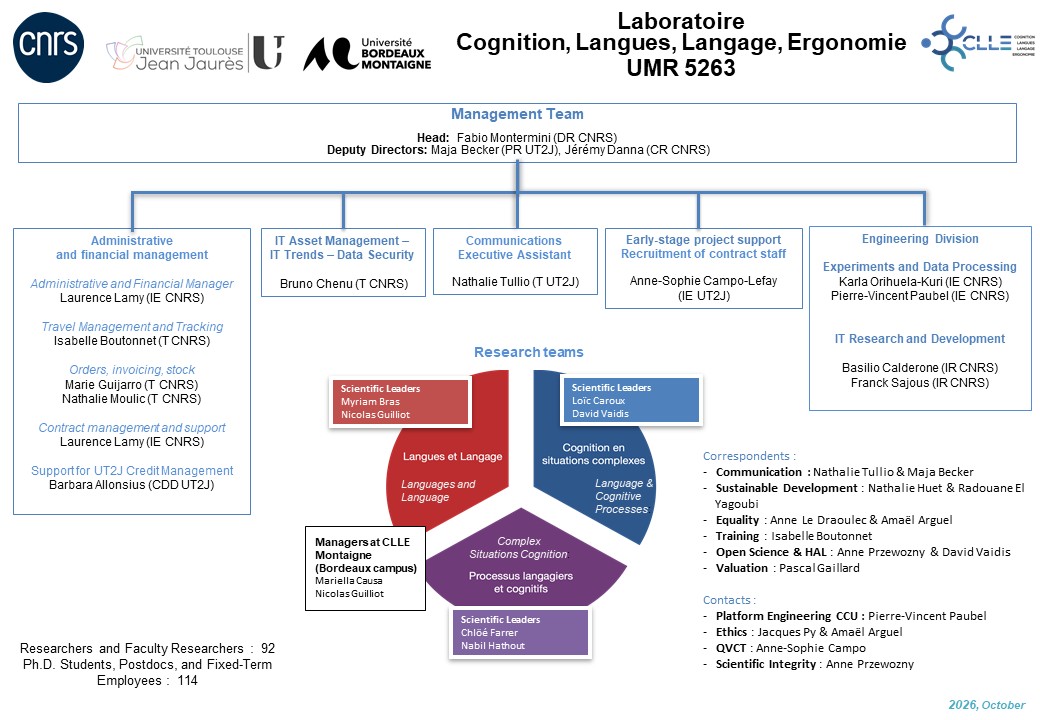 Download here
The laboratory is part of the CNRS Institute of Humanities and Social Sciences and is primarily affiliated with CNRS Section 36 (Language Sciences) and, to a lesser extent, with CNRS Section 28 (Cognition, Brain, Behavior) of the CNRS Institute of Biological Sciences. CLLE is therefore a multidisciplinary research unit within the field of Cognitive Sciences: the research conducted there spans the fields—to a greater or lesser extent—of linguistics, psychology, computer science, philosophy, education, and neuroscience.
Organization chart
Download hereThree research teams
Languages and Language: Myriam Bras & Nicolas GuilliotThematic groups:
- Linguistic Structures: Models, Variations, Usages (SlîM)
- Occitan, Romance Languages, European Languages: describing, formalising, developing tools, comparing (OCRE)
- Teaching French and other languages, Situated Linguistics, Teacher Training (DILIFOR)
- Discourse
Language and Cognitive Processes : Chlöé Farrer & Nabil Hathout
Thematic groups:
- Digital Tools: Cognitive and Linguistic Aspects
- Learning and Education
- Interactions, Multimodality, Variation, Culture
Cognition in Complex Situations: Loïc Caroux & David Vaidis
Thematic groups:
- Cognition, Interaction, Innovative Technologies
- Society–Individual Interactions
- Memory, Assessment and Decision-making
The laboratory’s major cross-cutting themes:
Education and training (pedagogy, learning, acquisition)Culture and society (linguistic and cultural diversity, sociolinguistics)
Digital and innovative technologies (uses, acceptability, design)
Aging (lifelong development)
Artificial intelligence (ethics, machine learning models)
CLLE Coordinators
CCU Platform Engineering: Pierre-Vincent Paubel
Ethics: Jacques Py & Amaël Arguel
QVCT: Anne-Sophie Campo
Scientific Integrity: Anne Przewozny
Sustainable Development: Nathalie Huet & Radouane El Yagoubi
Equality: Anne Le Draoulec & Amaël Arguel
Training: Isabelle Boutonnet
Open Science & HAL: Anne Przewozny & David Vaidis
Outreach: Pascal Gaillard
Ethics: Jacques Py & Amaël Arguel
QVCT: Anne-Sophie Campo
Scientific Integrity: Anne Przewozny
Liaison Officers
Communication: Nathalie Tullio & Maja BeckerSustainable Development: Nathalie Huet & Radouane El Yagoubi
Equality: Anne Le Draoulec & Amaël Arguel
Training: Isabelle Boutonnet
Open Science & HAL: Anne Przewozny & David Vaidis
Outreach: Pascal Gaillard